
Hey you, yes you,
The one holding a pen right now and wondering if you should finally fill that blank page. : )
A few weeks ago a buddy asked me over WhatsApp:
“Chou-Tac, what does SKETCH actually mean?”

I stared at the blue sky and realized… most people just say “draw”.
Designers and artists only would often use the word “Sketch”.
That tiny question hit me hard, because once I really figure out the difference between Sketching and Drawing, my whole design life leveled up. Because as Product Designer I sketch 90% of the time, and draw for 10%.
So today I’m spilling everything on how this creative mindset shift will make you 10× faster, more creative and happier!
Drawing and Sketching. Same-Same but Different!
Singaporeans have this famous slang expression: “Same Same but Different”.
And that totally applies when we compare Drawing vs Sketching!
If I ask you, what differences would you tell?
Here’s my super simple breakdown:
- Sketching = quantity of rough draft, unfinished, zero pressure
- Sketching = thinking out loud with a pen
- Sketching = your personal hard disk for ideas
- Sketching = trampoline for creativity (boing boing, new idea!)
- Sketching = universal language
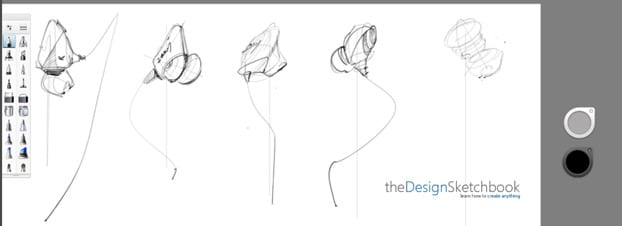
For example when I was sketching new forms of Sony earphones super fast, instead of drawing a unique and perfect proposal. Why? Because the danger of trusting your first idea can be misleading, and stop you from many more fresh innovative ideas you never gave yourself the chance to explore.
Drawing = slow, relaxing journey to one quality and perfect piece that let people for interpretation.
Drawing = you commit, you polish, you add soul. Beautiful… but if you are a designer, prioritizing drawing over sketching can be dangerous when you’re on a deadline!
Remember,like how Nick Huber says: a designer is not paid for pretty drawings, but for ideas!
The 90/10 Rule: Why Designers Sketch 90 % of the Time and Only Draw 10 %
Understanding the difference between drawing and sketching seems trivial, but it can influence the way you create and think. Sketching is more “sharpening the saw.” of your design projects.
Allocating time at sketching more than drawing allow you to:
- Multiply your ideas fast, by adapting your drawing style to your purpose.
(From rough styler for research, to meticulous style for a final presentation of your project for example) - Save you hours of time by organising your creative process towards productivity
- Protect you from frustration from failing after a long session of drawing that fail.
- Communicate your ideas clearly and faster.
Sketch loose and wild to explode ideas. Never to “finish” them. Draw clean and precise only when you’re committing to communicate or build an official and final presentation of your project.
Design with Users as your Priority, not Art Expression
One key distinction lies in purpose and audience.
- Artists typically draw from personal passion or inner inspiration, crafting for self-expression where viewers interpret the result freely.
- Designers, however, sketch with a practical focus to meet client briefs, they have a deadline and solve real-world problems, and deliver satisfaction. Designers feel pressure to create great products for others.
- While many artists and designers blend both approaches, thinking this way helps you stay clear about what you want to achieve and choose the best process to reach your goal.
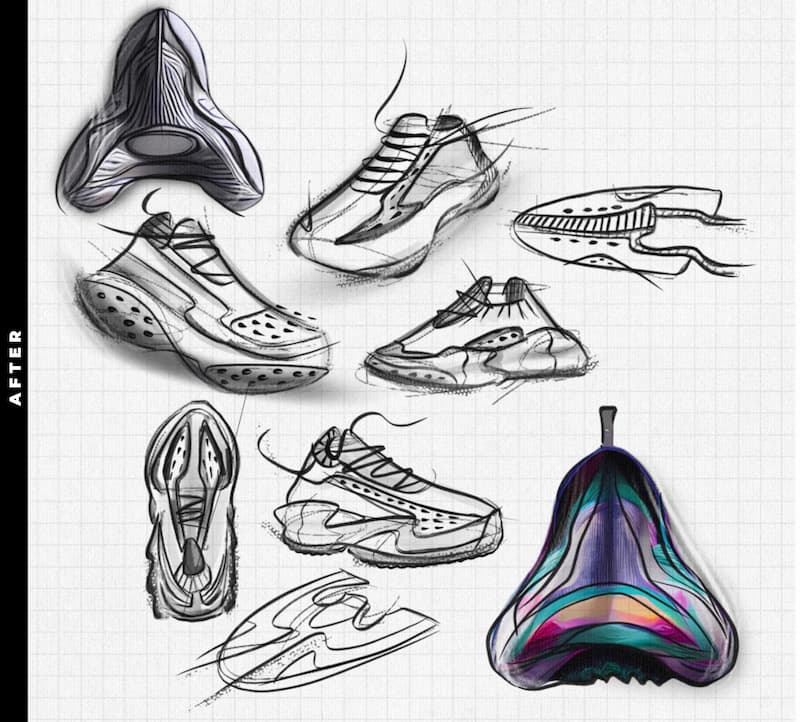
- (On the right)
My student Marina Aperribay (VIP Sneaker Sketch Pros Course) sketching Sneakers from multiple angles
Why Sketching Is More Than Art – but a Professional Communication Tool
My student Antonio (VIP student Sketch Like The Pros) accepted to share his design sketching tips on how to make a sketchbook with us:
Sketching provides a quick and freehand way to capture ideas instantly.
It emphasizes form, energy, and the core concept rather than precise lines or details.
- In fashion design, the sketch, known as a croquis or esquisse, is transmitted to a pattern maker who translates it into technical drawings with size specifications ranging from XS to XL.
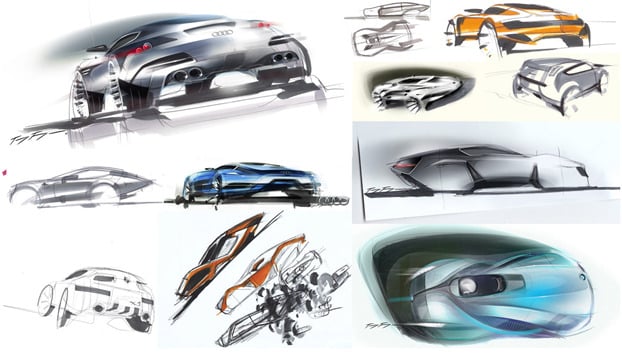
- In automotive design, sketches guide the clay modeler in creating a three-dimensional form.
- For footwear design, sketches are handed over to pattern makers, often overseas, who develop the detailed technical packages.
Designers never work alone; sketching serves as their essential tool to visually express creative ideas to others.
Sketching facilitate communication with technical teams, enabling the transformation of concepts into tangible products.
- (On the right)
Michael DiTullo Sketches of Speakers POLK
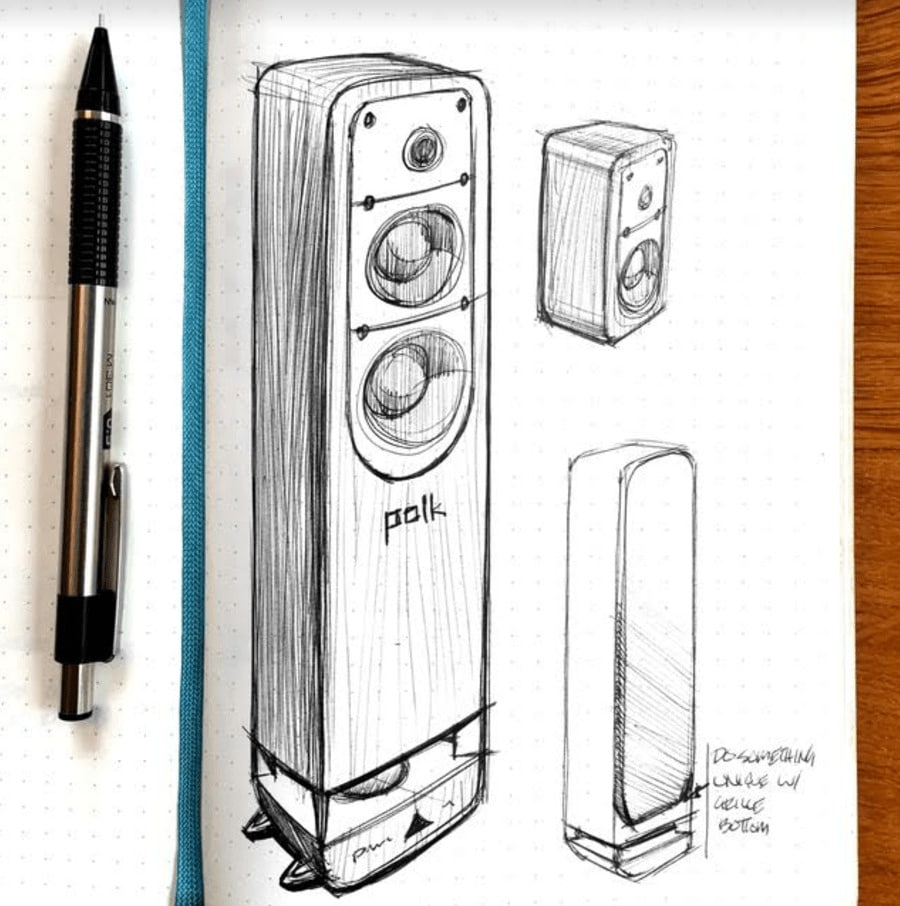
Not only the technical team, but designers also present and convince the marketing team about their projects. This requires clear and effective sketch communication to bridge creative ideas with marketing goals and business strategy.
Michael DiTullo shares that the most difficult part in design is not having an idea, it is to protect it.
When you present your ideas, you will face technology challenges, costing, marketing, safety…
The more you are able to convey your ideas visually, the less troubles you’ll have to convince.

Why Do Designers Make Sketches?
I teach Fast Sketching at The Design Sketchbook blog because it’s the most efficient way for designers to come up with ideas fast. While portrait artists spend hours to copy somebody’s face looking for realism, in design, I look for creativity and new ideas.
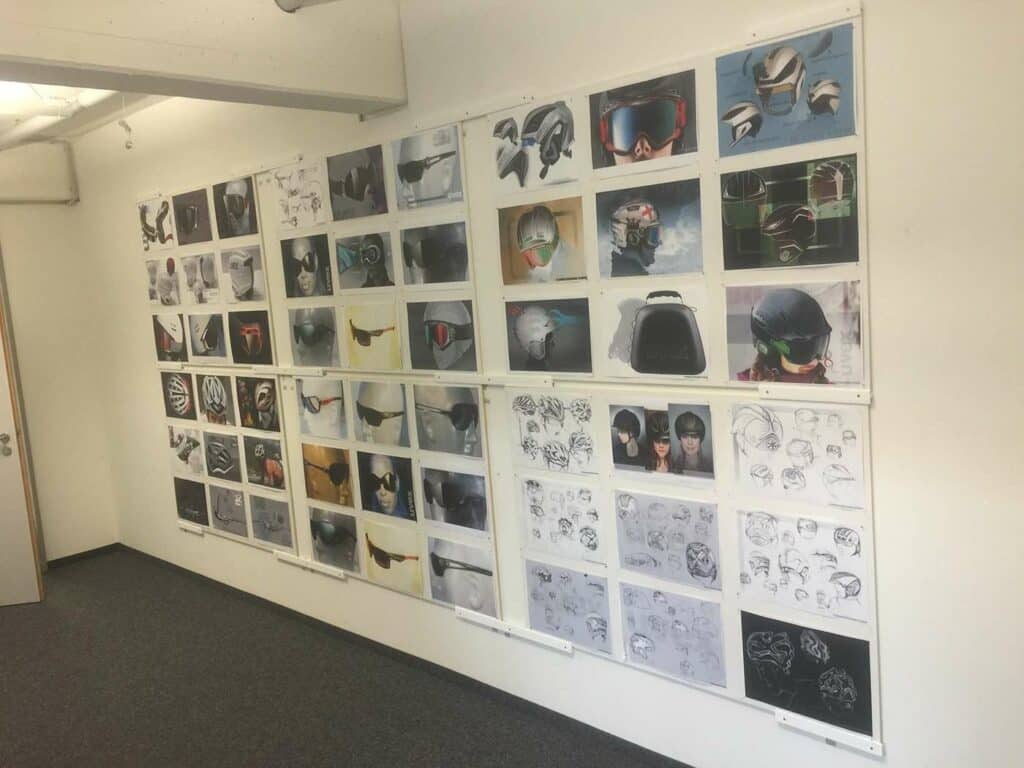
Noah Sussman, former sport designer at Adidas and currently at UVEX (See his sketches below) do not hesitate to display his sketches and inspiration all over the wall to have a wide vision on his project.
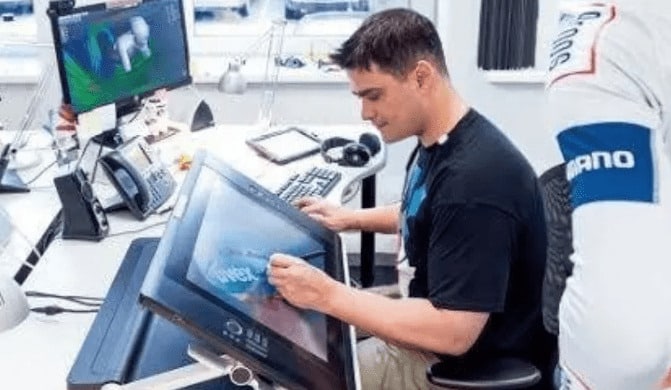
See Sketching as an ongoing creative process, while Drawing is more like a unique and final result.
There is something mesmerizing about fast sketching: watching a blank paper spring to life as a designer’s lines transform into vivid ideas in real time. It’s like looking at a flower blooming. You know the satisfaction when you make a sketch, and suddenly something cool come up. I like that feeling.
This is why as a designer; I often love spending time sketching new ideas than spending hours on one drawing.
No right no wrong, I love doing both.
Remember that designers sketch to:
- Generate and Explore Ideas: Quickly translating thoughts into visuals to explore many possibilities freely.
- Solve Problems Visually: Breaking complex concepts into tangible elements to test and improve.
- Relieve Mental Load: By externalizing ideas, sketches lighten brain memory pressure and can be revisited anytime, days, weeks, or years later. To me, sketching ideas on paper is equivalent to save a file on a hard disk.
- Encourage Iteration: Rapidly explore multiple versions and combine the best ideas for stronger solutions.
- Communicate Across Cultures: Having worked in Germany, Japan, and China, I’ve relied on sketches as a universal translator when language barriers arose. You can’t talk the same language? Sketch!
- Clarify Concepts: Sketches help explain ideas more clearly than words with clients, teams, and manufacturers. A sketch speaks 1000 times more than words.
- Work Efficiently: Sketching enables delivering ideas faster than 3D modeling or any detailed drawing. A common beginner designer mistake is to spend too much time on a final drawing on one idea, while the fundamental concept has not been confirmed yet.
- Develop Personal Design Language: Regular sketching improves hand-eye coordination and expressive skills.
Why Designers Draw Small Sketches (Thumbnails) First
Let me share with you a vivid memory from my Product Design Innovation class: our teacher required us to produce tons of ideas weekly. Before even opening our work, he weighed our sketch piles, praising those heavy with creativity. This reinforced that quantity breeds quality, and that we should not fall in love with our first idea.
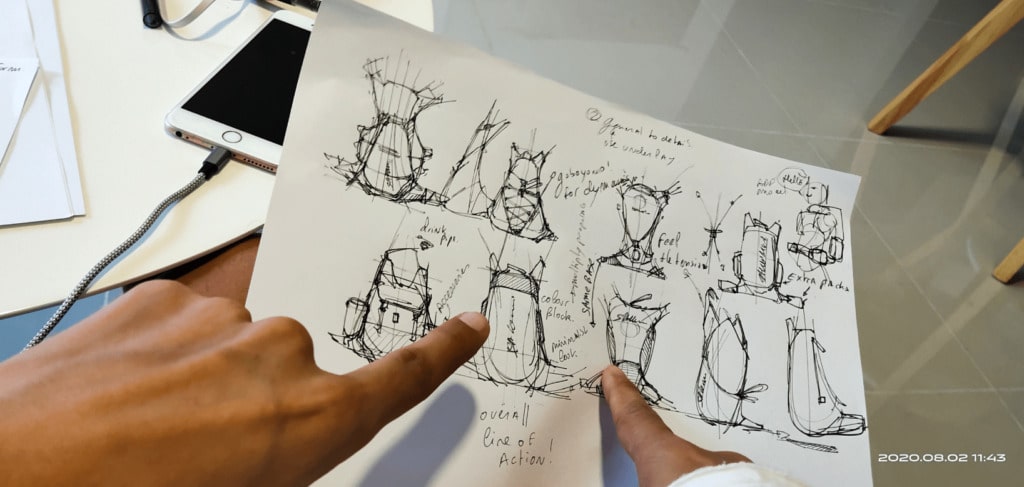
Thumbnails are tiny, rough sketches that designers use to quickly test composition, scale, and proportion before refining. This low-pressure step keeps the creative flow light and playful, just like cartooning frames from a storyboard that hooked me as a child. (After becoming a video game tester, I wanted to become a story board artist)
Compare these small thumbnail sketches like when you write a note, a phone number spontaneously on a piece of paper or your hand. Your handwriting does not have to be nice. It’s just a memo note for yourself.
The Magic of Ugly Doodles (Yes, Ugly on Purpose!)
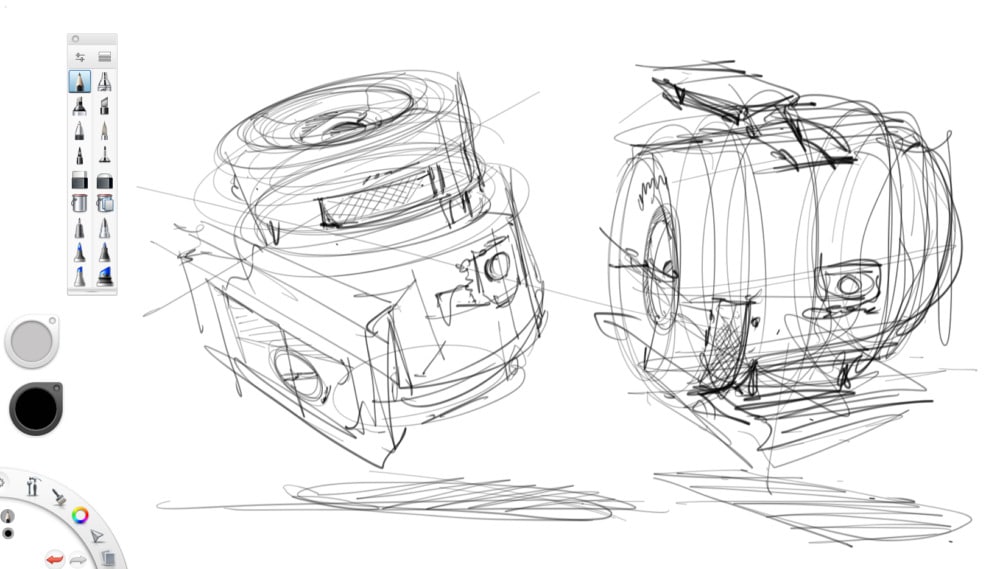
Try this tonight, seriously, do it with me
- Grab the back of a receipt or cheap copy paper
- Draw postage-stamp size boxes (3 × 3 cm)
- Set timer for 10 minutes
- Fill 30–50 boxes with any idea for, say, a new water bottle!
Zero perspective rules, zero pretty lines. Just pure “vomit of ideas”. You’ll laugh at how ugly they are… and then you’ll spot one gem. That’s the magic.
Why Is Sketching So Important?
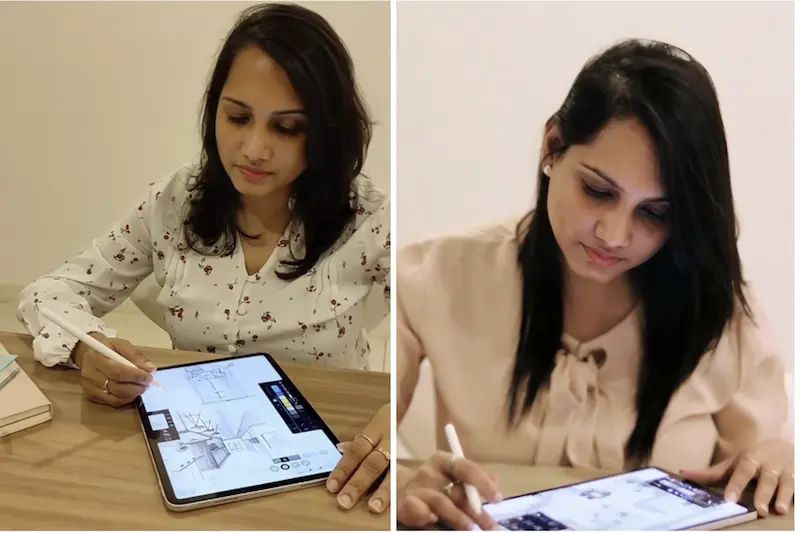
By doodling your ideas rough and fast, you avoid the pressure of perfection. At that stage you may even skip drawing with a correct perspective or proportion – as long as at least you, can understand it.
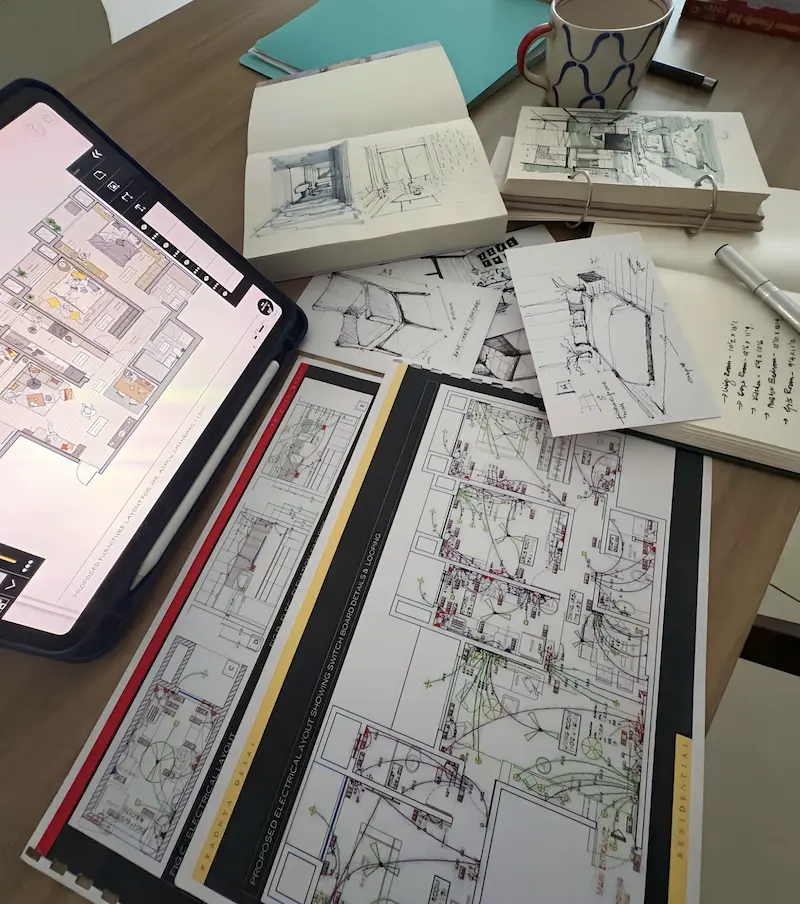
- (on the left) Pradnyaa Desai sketching interior design on iPad
Sketching is the fastest way to unleash ideas visually.
As a Designer, speed matters to deliver your project respecting tight deadlines.
Enabling fearless experimentation and clear communication beyond words.
When you zoom out, the designer is at the core of a spiderweb. He is at the center of the
- Marketing team
- Engineering team
- Material sourcing team
- Clay modeling team
- Business department
- Factory and suppliers.
As a Designer in an era where good design is more important than anything else, you are a creative leader.
This is one of the reasons why Jony Ive Design department were so essential under Steve Jobs.
See what happened with Tim Cook? The iPhone design remains the same for years. They succeed to compensate with marketing stunt, while Samsung, Oppo, Xiaomi… innovate while Apple is now behind.
Your ability to sketch, to communicate your ideas, stories can worth billions.
What Is the Primary Purpose of Sketching?
Its core purpose is to get ideas on paper efficiently to communicate fast:
- You externalize your thought on paper (or tablet)
- You accelerate creative problem solving.
- You communicate your ideas visually 100 times better and faster than words.
Sketching is the best way to start any project with some fast doodles.
You want to come up with ideas fast to ignite and develop even more ideas!
What Is the Most Important Rule in Sketching?
Never aim for perfection.
While I teach my students to master their pen drawing straight lines, perfect circles, ellipses freehand for their drawing fundamentals, when it comes to sketching ideas, use rough and loose lines.
Sketching is for discovery, not finished art.
However, remember to better you master the basics of drawing, the better you can break the rules when you sketch.
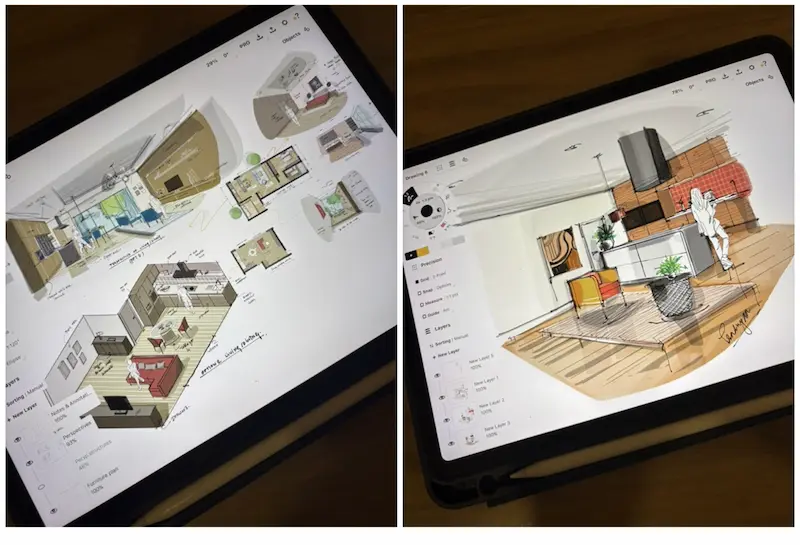
You can see below different stages of Pradnyaa Desai from sketches to technical drawings of Interior Architecture.
What I like with her sketches, is that imperfection that give the designer margin for personal expression through her sketching style.
Sketching for Product Benchmarking and Trend Observation
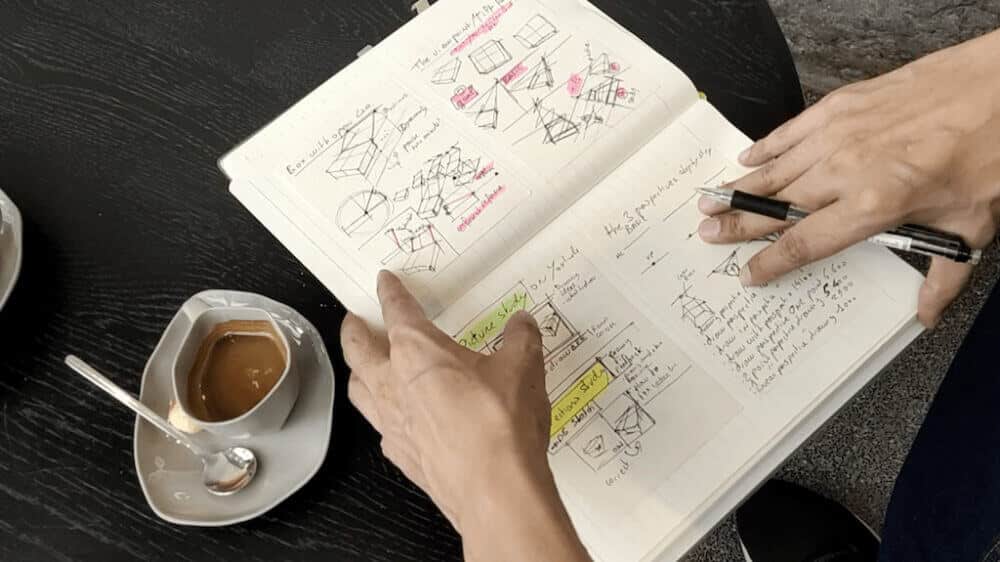
Sketching helps capture product details and trends with sharp observation, creating visual archives to revisit and expand. As a designer, a great habit is to carry a sketchbook to drop in any cool idea you may find. You don’t aim drawing well in it but recording some personal notes with doodles and quick annotation.
Example: You are walking in the street and see someone listening to music with a super cool headphone?
Draw it and focus on what you find it special in your sketchbook! You don’t have to redraw it fully perfectly, you want to annotate maybe the cool strap, or the ear cushioning system, the material…
As a designer hunting for ideas, sketch daily to act like a “color picker,” sampling fresh inspiration, and an “idea picker” that spots competitor benchmarks and sniffs out hot trends.
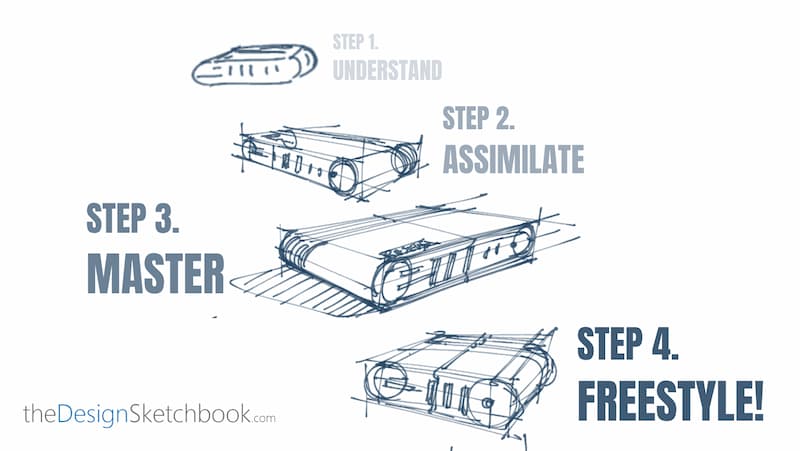
The 4 Levels of Sketching Fidelity Every Designer Should Master
- Level 1 → Ugly doodles only you understand
- Level 2 → Rough but readable exploration
- Level 3 → Clean “wow the client” sketches
- Level 4 → Final sexy render with your own style! (the 10 % everyone sees on Instagram)
Live in level 1–2 most of the time. Trust me.
Along these 4 sketching styles, you balance speed, clarity, creativity, and polish.
Why Embrace Ugly Doodles?
Most sketches you make are personal and won’t be show to anyone.
Do not hesitate to make ugly doodles that only you understand.
Ugly doodles are like the draft of a love letter. : )
You may write many of them and throw away even more. And that is ok, because each draft will make your final drawing outcome of your product more creative.
Ugly Doodles are fearless experiments that break creative blocks and build confidence. They are the foundation of productive sketching. Avoid trying to make perfect drawing all the time. As a designer, your intent is to provoke new ideas. Only later stage, you’ll need to draw a quality render of one of your ugly doodles to present.
Ugly doodles form is your crucial base to start any design project.
Drawing Is a Relaxing, Mindful Art

Drawing is a calming and mindful form of art.
It encourages slowing down to add texture, tone, and detail, allowing the artist’s soul to shine beyond practical purpose. Often, artists choose colors and shapes based on instinct and unconscious feelings rather than strict rules or technical guidelines. There’s no brief or budget, just the desire to express emotions through art.
A few days ago, I went to a Vietnamese Contemporary Art Gallery.
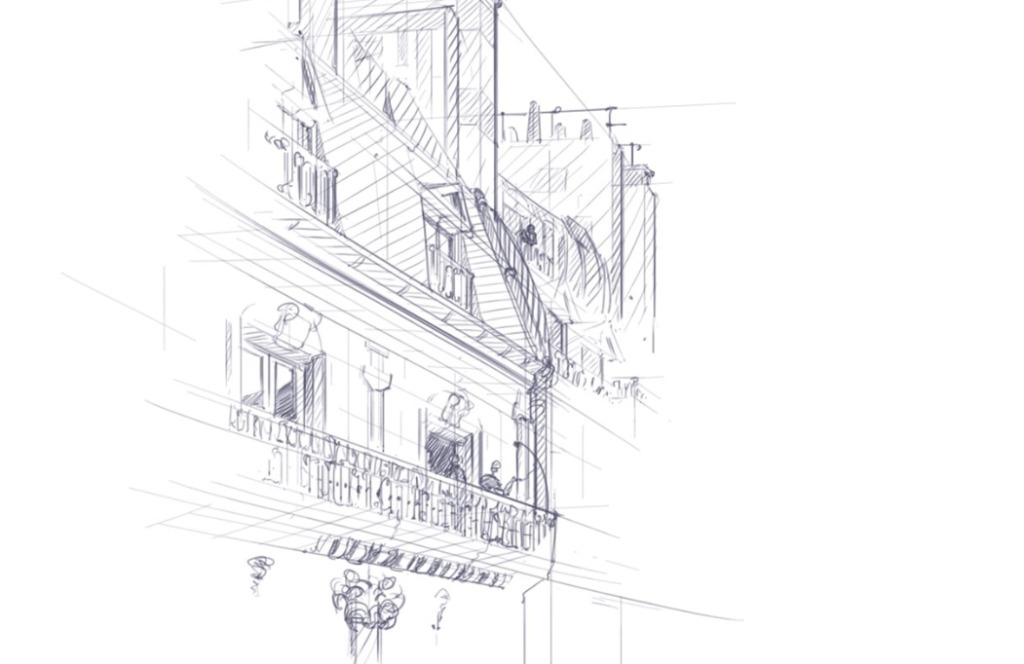
Personally, I enjoy urban sketching, where you can explore new places with your pen in hand.
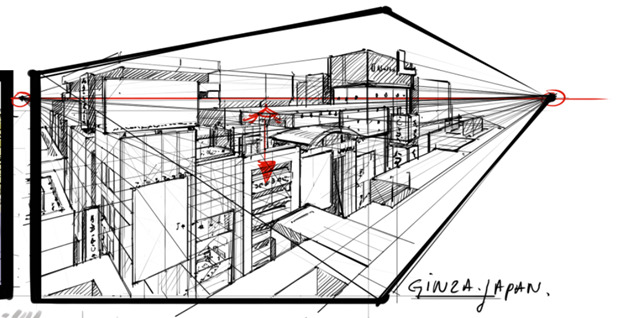
Sitting somewhere in a cafe, or on the ground floor, you spend hours capturing people, streets, and architecture, freezing moments you observe and sharing them through your unique perspective.
Balancing Sketching and Drawing
Early perfectionism is toxic.
The skilled designer knows when to sketch freely and when to draw meticulously. Both are essential.
My course, “Sketch Like The Pros”, teaches how to sketch energetically and work confidently with digital tools.
You want to spend a more detailed time and refinement drawing an attractive presentation of your product only when you have well defined your product concept. 90% of your time should be sketching, 10% on Drawing. Not the opposite or your creative output may end dry.
Tool Differences in Sketching and Drawing

In industrial design sketching, speed and clarity are paramount to communicate ideas fast.
Designers often favor fast sketching tools such as ballpoint pens, markers, Posca pens, and white pencils. These allow swift, expressive lines and easy layering of highlights, supporting rapid iteration and visual exploration.
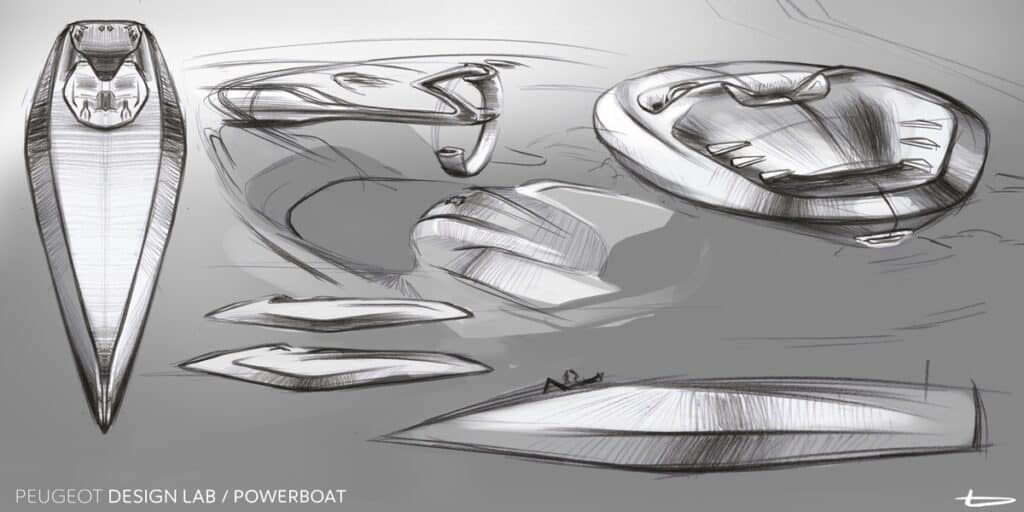
Traditional drawing takes a slower, more deliberate approach.
Artists use pencils graded from 8H (hard, light) to 2B (soft, dark) to build subtle tonal gradients. Watercolors and acrylics add depth, texture, and color richness over time. Drawing focuses on tonal variations and artistic expression rather than quick conceptualization. For example, in sketching I rather use hatching than a shade of grey with a pencil.
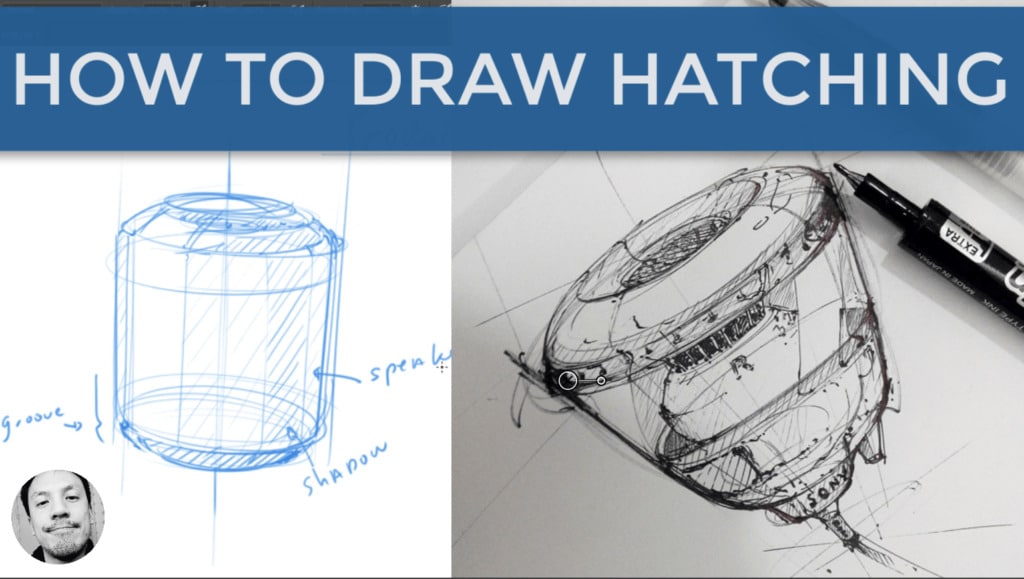
This explains why industrial designers rely on quick, reliable pens and markers suited for iteration, while drawing practitioners use a broader range of pencils and paints for detailed rendering and creativity.
I teach design sketching using only the Ballpoint pen, and forbid the eraser.
So you are not tempted to erase your mistakes, but learn from them, and iterate.
Quick Cheat Sheet: Sketching vs Drawing
| Aspect | Sketching ( Croquis) | Drawing |
|---|---|---|
| Speed | Fast and spontaneous | Slow and deliberate |
| Purpose | Capture ideas and visual notes | Create polished artworks |
| Style | Loose, raw, energetic | Detailed, refined |
| Pencil Pressure | Light and flowing | Firm and controlled |
| Emotional Impact | Expresses energy and emotion | Focuses on precision and tone |
What Sketching is Not
Haha! To clarify everything, I made a “What Sketching Is NOT” list:
- It’s not warm-up for drawing
- It’s not failed drawing
- It’s not only for “talented” people
- It’s not optional if you want to be fast and creative
That would kill the last remaining excuses people have.
So… Ready to Embrace the Ugly Sketching?
Next time you feel stuck, don’t open Procreate or Photoshop for a perfect render.
Grab the ugliest ballpoint pen, make the messiest doodles, and laugh at them. Those ugly doodles are the foundation of every million-dollar product you love.
You’ve got this. Every single designer you admire started with terrible sketches.
The difference? They never stopped. Now go make some beautiful mess.
Keep the pen moving!
Cheers,
Chou-Tac
Always remember: sketching is about work, while drawing celebrates mindfulness and artistry.

Recommended Articles
TIP 150 How to Draw Straight Lines with Confidence (+ Common mistakes)
Capture a Moment of Life [Draw People in Real-Time]
TIP 244 How to Draw in 3D with the “Move The Dot Technique” (2-Point Perspective)
TIP 149 Wonder What to Draw? Start Sketching Your House Today!
TIP 214 Surround yourself with passionate people to grow your sketching level.








Add comment